Buying Guide
How to Order Custom Concrete Candle Vessels at 1,000 Pieces
A practical guide for niche candle brands placing their first custom concrete vessel order: what 1,000 pieces covers, how the custom process works, and the checks to run before you send your drawing.
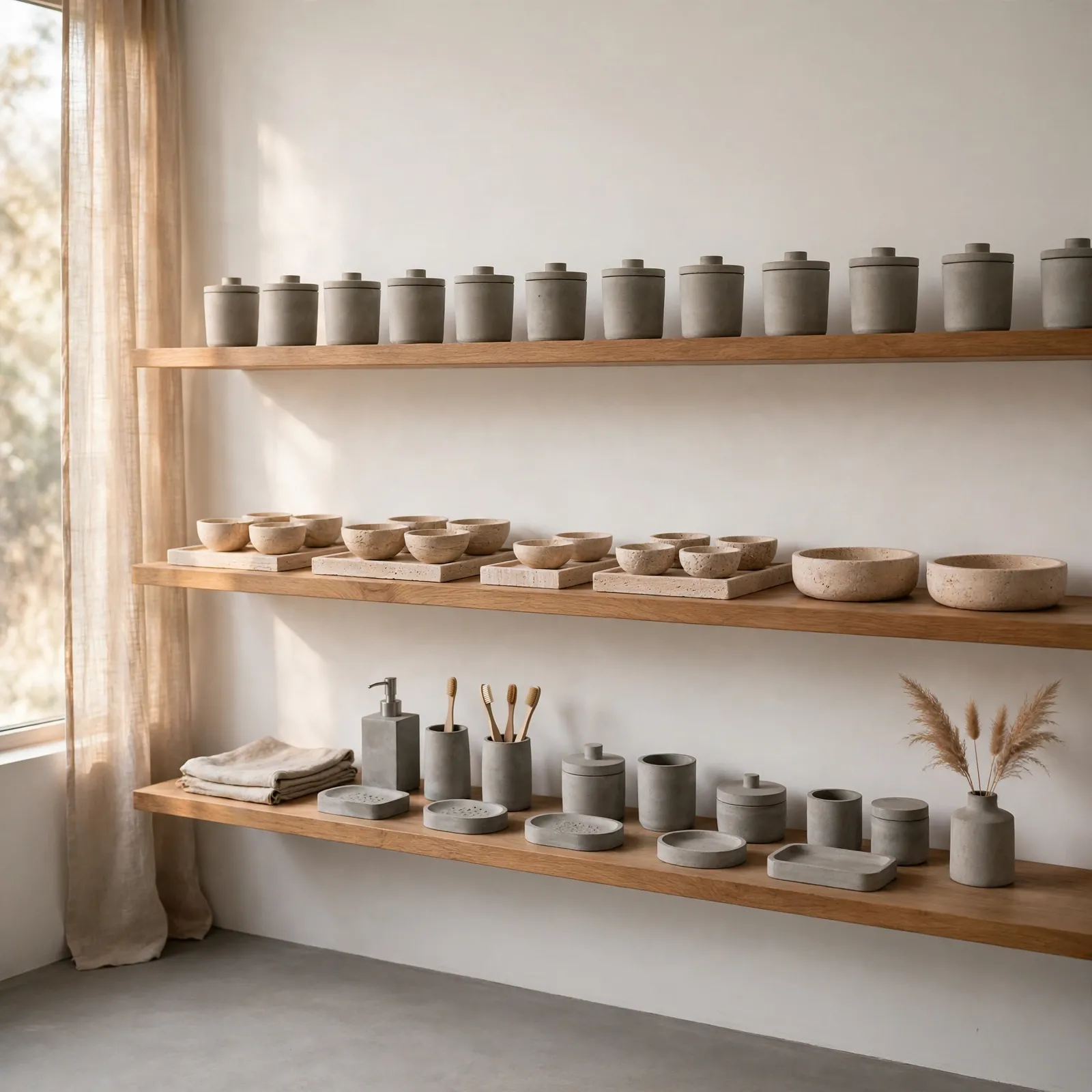
Yes — 1,000 pieces is enough to order a custom concrete candle vessel made to your own shape, colour, size and material, with your logo laser-engraved and a sealing lid and gift box. Laki Living, a design-driven concrete craft manufacturer in Huizhou, China, founded in 2018, works from your drawing or 3D file and can produce a physical sample in as fast as 3–5 days. This guide is for you if you run a niche candle brand and want your first order to carry your own vessel instead of a stock jar. It is not for you if you only want ready-made stock with no customisation at all. If you have already asked two or three factories for a quote and every reply came back with a minimum you cannot meet, the problem is usually not your design — it is that the order was never framed the way a factory can accept it.
Why Small Orders Keep Getting Turned Away
Picture the week you decide to move your candle line into a vessel of your own. You have a sketch on your desk, a reference colour swatched against your label, and a launch date circled on the calendar eight weeks out. You send the sketch to three factories. The first says the order is too small. The second quotes a mould fee that costs more than the vessels themselves and adds that the colour cannot be changed. The third never replies at all. By Friday you have spent five days chasing answers, your launch date has not moved, and the vessel you imagined is still a drawing.
That week is familiar to almost every small candle brand owner who has tried to order a custom vessel for the first time, and it is rarely a sign that your design cannot be made. What stops a small order is usually the way it arrives. A sketch with no dimensions, a colour described as "warm grey" with no reference swatch, and a quantity given as "about a thousand" leaves the factory with three questions it cannot answer, and the easiest answer to give is no. The order gets pushed aside because the factory cannot price, schedule or sample an order it cannot see clearly. Once you understand which pieces of information a factory needs before it can say yes, a 1,000-piece order stops looking like a favour and starts looking like a normal first order.
What 1,000 Pieces Actually Covers — and What It Does Not
The first thing to settle is what the number counts. A minimum of 1,000 pieces sounds simple, but in practice a factory can count it in more than one way: 1,000 pieces of one design, 1,000 pieces of one colour, or 1,000 pieces across a set of matching pieces. The difference matters. If you want your vessel in two colours, you need to know whether the minimum applies to each colour separately or to the order as a whole, because it changes your quantity, your price and your launch plan. Ask the factory in writing how the 1,000 pieces are counted — per design, per colour, or per set — and keep the answer with your order. A factory that answers that question clearly in writing is a factory you can plan around.
The second thing to settle is what you can change. A custom concrete candle vessel at Laki Living is custom in four dimensions: shape, colour, size and material. Shape means the vessel itself — the cylindrical form, the sealing lid, the proportions you specify. Colour means exclusive matching to your brand palette, not a choice from a short list of stock colours. Size means the dimensions and capacity your wax fill requires, and material means the concrete body, with marble-look or travertine-look finishes where your range calls for them. Your logo is laser-engraved, which gives a crisp, permanent mark rather than a printed label that can wear. A gift box is available if your vessel is sold as a gift set. Each design and each colour is its own run, and the minimum applies to the run you define.
The third thing to settle is the evidence you need before you can compare one factory with another. A quote that lists only a unit price tells you almost nothing. You need a written list covering the mould fee and who carries it, the sample fee, the unit price at 1,000 pieces, and what is included in the packaging. Without it, two factories can quote the same number and deliver very different orders. Laki Living runs its own factory in Huizhou Zhongkai, Guangdong, in a 9,800-square-metre workshop, and is a SGS Verified Supplier at factory level — which describes the factory, not a certificate for any single vessel. What you should ask for is the written list, the sample, and the answers to the counting and customisation questions above.
Four Moves That Get Your First Order Placed
The order becomes straightforward once you work through it in four moves. First, prepare your drawing or 3D file, your reference colour, and your decision on the lid and the gift box. A drawing with dimensions lets the factory open a mould from it. A reference colour — a Pantone number, a physical swatch, or a sample of your label — beats a colour name, because "warm grey" means a different shade to every reader. Decide before you write whether your vessel needs a sealing lid and whether it ships in a gift box, because both change the mould and the packing.
Second, confirm the counting method and the custom dimensions in writing. Send the factory your drawing and ask it to confirm, in the same reply, how the 1,000 pieces are counted, which dimensions are fixed by the mould and which can still move, and what the logo engraving covers. If the counting method is not in the reply, ask again before you move on.
Third, confirm the sample. A physical sample can be ready in as fast as 3–5 days from your drawing or 3D file. When it arrives, check four things: the colour against your reference, the logo engraving for crispness and position, the sealing lid for fit, and the size against your wax fill. If any one of the four is wrong, say so now, while a correction costs a second sample and not a thousand finished vessels. Do not approve a sample from a photograph alone if you can hold the piece in your hand; weight, surface and lid fit do not show up in a picture.
Fourth, confirm the bulk lead time and the packaging in writing before you commit. The bulk lead time is not a number to assume, so ask for it in the same written confirmation and plan your launch date around the answer. On packaging, the factory states that finished packing is tested to a 1.2-metre drop standard and uses high-density EVA inserts moulded to each product — treat that as the factory's own claim, ask what evidence supports it, and request photos of the packed product before you approve the order.
Three Situations Where You Should Not Order Yet
There are three situations in which the right move is to hold the order. The first is when the size, capacity or heat resistance of the vessel is still unconfirmed. A candle vessel holds hot wax, and a vessel whose capacity or heat behaviour has not been confirmed is not ready for a bulk order. Ask for the confirmation, and if the factory cannot give it, wait until it can. The second is when the sample has not been approved. Never pay for bulk production on the strength of a photograph or a promise that the sample "will be fine". The sample is the contract in physical form: colour, logo, lid and size, all four checked, all four right. Until that piece is in your hand and approved, the order is not ready. The third is when the counting method or the fees are still not in writing. If you do not know whether the minimum is counted per design or per colour, or whether the mould fee and sample fee are included, you do not yet know what you are buying.
What to Send With Your First Enquiry
When you are ready, send one enquiry that contains everything the factory needs to reply with an executable plan instead of a round of follow-up questions. Include your drawing or 3D file, your reference colour, your quantity of 1,000 pieces, your target market, and the date you need the goods. State the lid and gift box decision, the counting question, and ask for the written list of mould fee, sample fee and unit price.
Start with the vessel itself: the Custom Cylindrical Concrete Candle Vessel with Sealing Lid is the piece this guide is built around, whose product page shows the shape, the lid and the gift-box option. Send your enquiry through the inquiry form with your drawing and this checklist attached, and you will have your first custom vessel in hand as a physical sample in as fast as 3–5 days — and a first order you can place with confidence.