Custom Guide
Concrete Vessel Sampling in 3-5 Days: What to Prepare
Your concrete vessel sample can be ready in as fast as 3-5 days if your drawing, sizes, colour and logo arrive complete. This guide gives you the checklist so your first sample passes without rework.
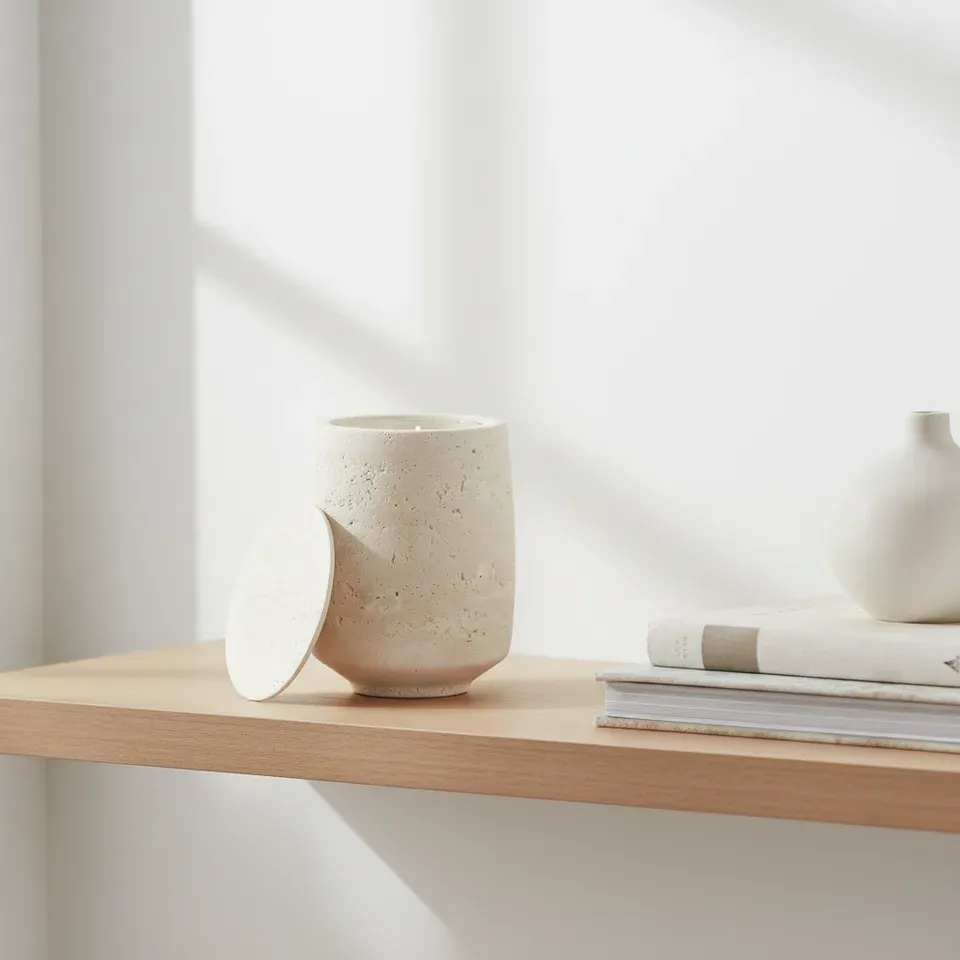
A custom concrete candle vessel sample can be ready in as fast as 3-5 days. That speed holds only when four things arrive complete in your first message: your drawing or 3D file, your size table, your colour reference, and your logo file. If even one is missing, the clock does not start on your sample. It starts on a round of questions back and forth.
This guide is for you if you are a candle brand owner or a homeware buyer with a finished design who needs a physical sample before committing to a 1,000-piece order. It is not for you if all you have is a mood-board image with no sizes or colours decided: settle the design first, then start sampling.
If your drawing has already gone back and forth three times and the mould still has not been cut, the problem is almost never the factory, and this article shows you exactly what was missing.
Sampling Is Slow Because the Brief Is Incomplete, Not Because the Factory Is Slow
Picture the week before your launch. Your scent is final, your gift box is printed, and the only thing missing is the vessel itself. You sent the factory a photo of a concrete jar you liked and asked how fast a sample could be ready. Instead of a date, you got questions: outside diameter, wall thickness, whether the lid seals, and which grey you mean. None of those questions means the factory is slow. Each one means the factory cannot cut a mould from a photo, and while you search for the answers, the sample waits.
You are not ordering a stock item off a shelf. You are asking a factory to build a one-off mould for your shape, mix your brand's own colour, and engrave your logo into the surface. Laki Living has made concrete vessels since 2018, in a 9,800-square-metre factory with its own mould workshop and in-house one-stop production, which is why a physical sample can be ready in as fast as 3-5 days once the brief is complete. But the workshop can only start when it knows what to build: a drawing without a wall thickness is a shape without a structure, and a colour described as a little warmer is a guess the factory has to make for you. The days you lose are the days between your first message and the moment the factory finally has enough information to begin.
Four Gaps That Stall a Sample Between Drawing and Mould
The first gap is drawing precision. A factory can open a mould from your drawing or 3D file, but only if it carries the numbers the mould maker needs: outside diameter and height, wall thickness, base thickness, and the lid structure, including whether it seals and how it sits on the rim. An appearance rendering shows what the vessel looks like on a shelf, not how thick the wall must be or whether the lid will close cleanly after the concrete cures. Send the drawing with dimensions marked, and include the lid in the same drawing.
The second gap is colour. Custom colour matching is one reason a brand chooses a concrete vessel: your grey is not another brand's grey, and your travertine look has its own tone. But a factory cannot mix your colour from words alone. Saying a little darker or a little warmer leaves the mixer choosing between a dozen shades, and the one that arrives may be close without being yours. What the factory needs is a reference it can match against: a colour card number, a physical swatch, or a photo of a finished piece taken in daylight. With a reference, exclusive colour matching has a target. Without one, you get samples in slightly different greys, each one costing you days.
The third gap is the logo. Laser engraving gives a concrete vessel a clean, permanent brand mark, but the file decides whether that mark comes out sharp or blurred. A small JPG pulled from your website will not do: the engraver needs a vector file that scales without losing its edges, plus the exact position of the logo on the vessel and the size it should be engraved at. Send the vector file, mark the placement on your drawing, and state the engraving size in millimetres, or the factory must stop and ask.
The fourth gap is the acceptance standard. When your sample arrives, you will judge it against something, and if that was never written down, the judgement becomes a feeling instead of a decision. Agree the four checks before the sample is made: colour against your reference, logo against your file and placement, dimensions against your size table, and the lid against its sealing fit. With those four checks agreed, you can approve the sample the day it arrives, or point to the one check it failed. Without them, the sample goes back with a note that it does not look right, and the next round starts over.
The Checklist: Send These Six Items and Start Sampling in One Go
Put the six items below into a single message and your request is complete. The first item is your drawing or 3D file, with dimensions, wall thickness and lid structure marked. Send it as a PDF or a 3D file the factory can open, not a phone photo of a screen.
The second item is your size table: outside diameter, height, wall thickness and the internal depth your wax fill needs. Write the numbers you actually want, not the numbers of a jar you saw online. Without the table, the factory builds to its own best guess, and a vessel that looks right can still fail your fill line.
The third item is your colour reference. Send a colour card number, a physical swatch, or a daylight photo of a finished piece you want matched, and name the finish, whether that is a marble look or a travertine look. Without a reference, the factory mixes to a description, the most common reason a first sample comes back in the wrong shade.
The fourth item is your logo file. Send the vector version, mark its position on the drawing, and give the engraving size. A sample made without the logo tells you nothing about how your brand will look on the vessel.
The fifth item is your quantity and your target market. State that your order starts at 1,000 pieces and name the market the vessels are made for: the factory plans the sample around the order behind it. The sixth item is your expected timing: the date you need the sample and the reason behind it, such as a launch or a buyer meeting. A date with a reason lets the factory confirm whether the fastest 3-5 day sampling window fits your plan before the mould is cut.
Three Situations When You Should Not Rush the Sample
There are three situations in which pushing for a sample only creates rework. The first is when the design is not yet decided. If you are still choosing between a straight cylinder and a tapered body, or between a sealing lid and an open rim, no sample can settle it for you: the factory would have to build two different moulds to show you both. Decide the shape first, then ask for the sample of that shape. The second situation is when the colour is not yet decided. A sample poured in a colour you are still debating proves nothing except that the mould works. Settle the reference first, and the sample you receive will be the one you can actually judge.
The third situation is when the logo file has not been given. A sample without your engraved logo shows you a vessel, not your product, and you cannot approve branding you have not seen. When the sample arrives, judge it against the four checks you agreed in advance, colour, logo, dimensions and lid seal, and nothing else. If a new idea appears while you hold the sample, save it for the next sampling round instead of adding it to this one: a sample that absorbs new requirements mid-round becomes a second sample wearing the first one's schedule.
Your Next Step: Run the Self-Check Before You Send the Sampling Request
Before you send anything, run the self-check once against the six items above and your four acceptance checks. If all six are in your message, send the request now. If any item is missing, fill that gap first: a complete request sent a day later reaches you sooner than one sent today that spends three days in questions.
Send everything once, and the factory can cut your mould once, without coming back to ask what you meant. If your design is a lidded cylindrical vessel, start from the Custom Cylindrical Concrete Candle Vessel with Sealing Lid product page; if you want a marble look, start from the Marble-Look Concrete Candle Holder product page. Then send your sampling request through the inquiry form on the website, with your six items and four acceptance checks attached. One complete message turns the fastest 3-5 day sampling window into the date your sample actually arrives.